Kitchen Water Damage in Centennial: Sink and Appliance Leaks
A kitchen leak rarely announces itself. You open the cabinet under the sink and find swollen particleboard, or you pull the dishwasher out and the subfloor is black. By the time most Centennial homeowners notice, water has already traveled under cabinet toe kicks, through the subfloor seams, and into the joist bays below. That hidden travel is what turns a small drip into a four figure repair.
At Centennial Water Restoration, we respond to kitchen losses across Central Indiana every week. Supply line failures, dishwasher gasket leaks, ice maker line splits, garbage disposal cracks, and slow sink drain leaks all show up with their own damage patterns. This guide walks you through what to do in the first hour, how the IICRC categorizes the water, what restoration actually costs in Centennial, and how to tell whether your cabinets and floors can be dried in place or need to come out. If we look at your kitchen and decide drying is not worth it, we will tell you directly. Founded in 2018, BBB A+ rated, and IICRC certified, our job is to give you the honest call, not the expensive one.
Why kitchen leaks cause more damage than they look like they should
Kitchens are a perfect storm of plumbing, appliances, and porous building materials packed into a small footprint. Under your sink alone you have a hot supply line, a cold supply line, a drain, a disposal flange, a dishwasher tee, and sometimes a fridge water line, all sitting on top of particleboard cabinet bases that swell the moment they get wet. Behind the dishwasher there is a braided steel supply line that manufacturers rate for about five to seven years, even though most people never replace one in the life of the appliance. The refrigerator has its own quarter inch line snaking through the wall or floor, often crimped behind the unit where you cannot see it weeping. Any of these can fail without warning, and because the leak point is hidden inside a cabinet or behind an appliance, the water has usually been migrating for days or weeks before you spot it.
The damage pattern follows the path of least resistance. Water runs down the cabinet kickplate, under the vinyl or tile, into the subfloor seams, and then sideways along floor joists. In a Centennial home with hardwood, you will notice cupping or crowning of the planks first. In a slab home, the water pools under the cabinet and wicks into the drywall behind it. In a home with a basement or crawl space below, you may not see any kitchen damage at all until water starts dripping through the ceiling below, which usually means the subfloor is already saturated. Our team uses thermal imaging and pinless moisture meters to map the actual wet footprint, because what you can see on the surface is almost always smaller than what is actually wet.
The materials that make kitchens beautiful are also what make them vulnerable. Cabinet boxes built from medium density fiberboard or particleboard absorb water like a sponge and lose structural integrity within hours, not days. Engineered hardwood flooring, which has become the dominant choice in new Centennial builds over the last decade, delaminates from below when moisture penetrates the seams, and the damage is often invisible from above until you press on a plank and feel it flex. Granite and quartz countertops survive fine, but the plywood substrate underneath them can rot if a sink rim seal fails and water trickles down the inside of the cabinet wall for months. We have opened up cabinets in homes where the homeowner thought they had a minor drip and found black staining across the entire base, soft drywall behind the cabinet, and mold colonies starting to bloom along the back of the toe kick.
What professional kitchen drying actually involves
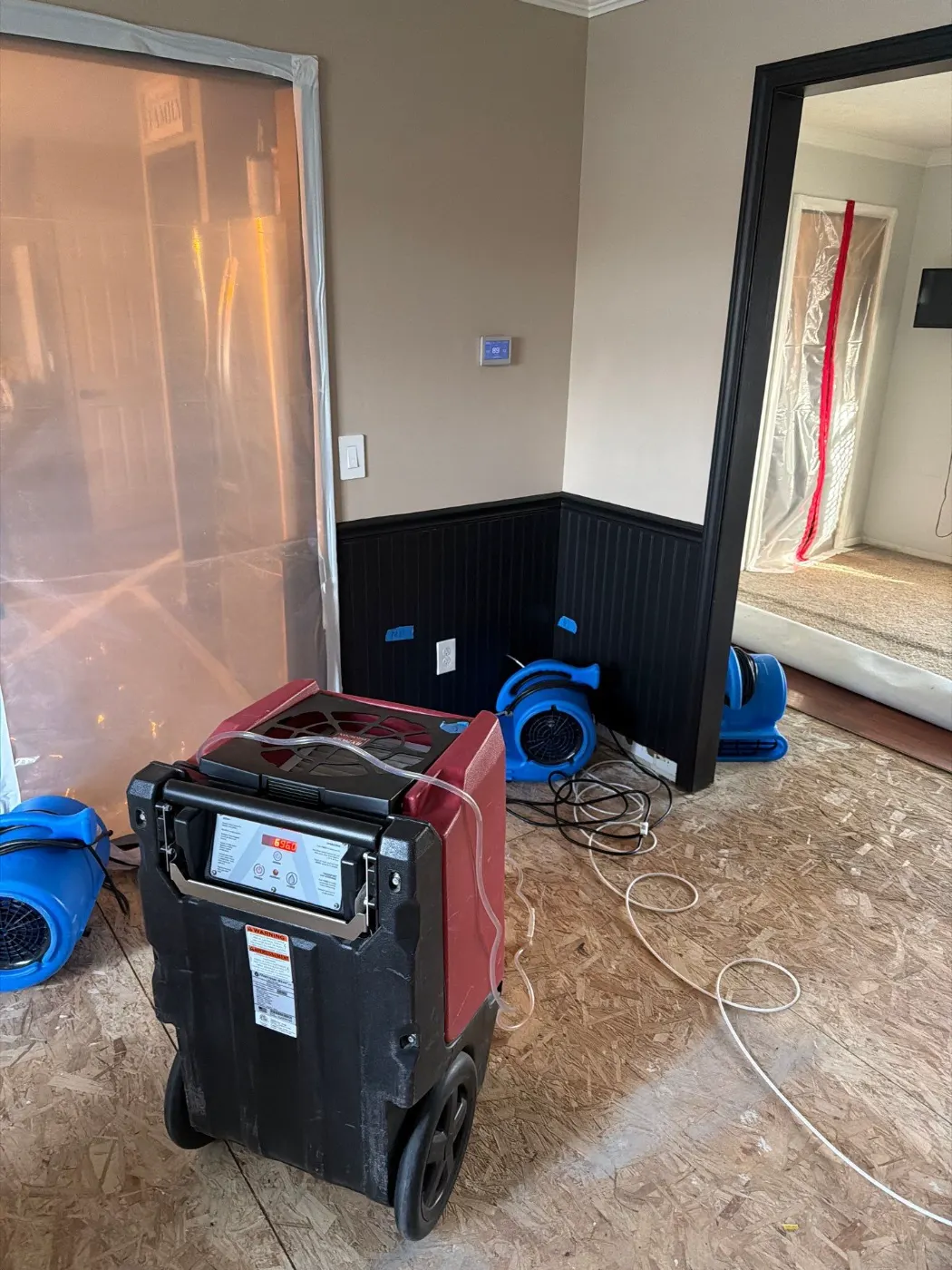
When we arrive, the first thing we do is map moisture, not move equipment. A typical kitchen job involves pulling the toe kicks off the affected cabinets, drilling small inspection holes in the cabinet sides if needed, and reading moisture content in the subfloor, drywall, and any adjacent rooms. From there, we set up containment so we are only drying the affected zone, not your whole first floor, which keeps your energy bill reasonable and the drying time short. Air movers go in low, directed across the wet surfaces, and a commercial dehumidifier pulls the evaporated water out of the air. Most kitchen dry outs run three to five days, with daily moisture readings to confirm progress. If the cabinet bases are particleboard and have swelled past the point of structural recovery, we will tell you, and that becomes part of the rebuild scope rather than the drying scope. The same logic applies to hardwood floors that have started to cup, where early intervention sometimes saves the floor and sometimes does not.
Cost in central Indiana typically runs $1,500 to $4,500 for a contained kitchen mitigation, depending on square footage, materials, and whether the subfloor needs partial replacement. Insurance generally covers sudden and accidental discharge from a supply line or appliance, which is the cause in most cases we see. Long term seepage from a slow drain leak is usually not covered, which is why prompt reporting matters. We document everything to insurance carrier standards and can work directly with your adjuster.
The rebuild phase, once drying is complete and moisture readings confirm everything is back within normal range, is where homeowners often face their biggest decisions. A single damaged cabinet run can sometimes be matched and replaced, but if your kitchen is more than ten years old, the original finish or door style may be discontinued, and partial replacement can leave a visible seam. We walk every Centennial Water Restoration client through these tradeoffs honestly, because a kitchen leak is stressful enough without surprises at the end of the project.
The first hour: what to do before anyone arrives
If you have just discovered an active leak, shut off the water at the fixture stop valve under the sink or behind the appliance. If those valves are seized, which is common in homes more than fifteen years old, go to the main shutoff. Kill power to the affected circuit at the breaker if water is anywhere near outlets, the dishwasher, or the disposal. Pull everything out of the cabinet and take photos of the damage from multiple angles before you move anything else, because your insurance adjuster is going to want to see the original scene. Lay down towels, but do not start ripping out cabinet bases or flooring. Premature demolition can complicate your claim and sometimes makes the drying job harder, not easier. For a step by step on what to do when it is a supply line that failed, our burst pipe water damage guide walks through the immediate response in more detail.
Then call us. A real conversation with a technician will tell you whether you have a simple clean water (Category 1) situation that can be dried in place, or whether you are looking at gray water from a dishwasher discharge that needs more aggressive sanitation. Most kitchen leaks we see in Centennial are Category 1 at the source but degrade to Category 2 within 48 hours if left sitting, which is why response time genuinely matters.
While you are waiting for Centennial Water Restoration to arrive, there are a few small things that genuinely help. Open the cabinet doors and drawers in the affected run so air can start circulating. If you have a box fan, point it at the wet area on low. Move any contents that can be salvaged, paper goods, cookware, small appliances, to a dry counter or another room. Resist the temptation to use a household wet/dry vacuum on standing water under the cabinets if you suspect it has reached the wall cavity, because that water is no longer accessible to a shop vac and you risk pulling drywall fibers loose. And do not pour bleach or cleaning solution on the area thinking you are getting ahead of mold. Surface treatment without first drying the substrate does nothing and can interfere with our moisture readings when we arrive.
When Your Centennial Kitchen Is the One in the Story
Kitchens hide water better than any room in your home. By the time you can see it, smell it, or feel it underfoot, the damage is already in the subfloor and creeping into the joist. The homeowners in these stories all thought they had a small problem. They all had a bigger one. Centennial Water Restoration responds across Centennial day and night, gives you a real assessment instead of a sales pitch, and tells you directly if the job is something you can handle yourself. Call when you are ready, and we will walk you through the next hour.
Frequently Asked Questions
How fast do I need to call after a kitchen leak in Centennial?
Within the first 24 hours if possible. Category 1 clean water turns into Category 2 grey water around the 48 hour mark, and mold growth starts between 48 and 72 hours. Centennial Water Restoration runs 24/7 dispatch across Centennial so you do not have to wait until morning.
Will my homeowners insurance cover a dishwasher or sink leak?
Most policies cover sudden and accidental discharge, which is what a burst supply line or cracked hose qualifies as. Slow long-term seepage is usually denied. Document the failed part and call Centennial Water Restoration before tearing anything out so the scope is written correctly.
Can you save my hardwood floor or do I need to replace it?
It depends on how long the water sat and whether it reached the subfloor. Engineered hardwood often delaminates and needs replacement. Solid hardwood can sometimes be dried in place with mats and dehumidifiers if we catch it inside 48 hours.
Do I have to remove my cabinets for the subfloor to dry?
Not always. We can often inject air under the toe-kick and pull moisture out without demo. If the particleboard cabinet base is already swollen or delaminating, removal becomes the cheaper long-term call.
What does a typical Centennial kitchen water damage job cost?
Most Centennial Water Restoration kitchen jobs land between $1,500 and $7,500 depending on whether subfloor and cabinet work is needed. Insurance usually covers the full amount minus your deductible when the cause qualifies as sudden and accidental.
Have a restoration question?
Our IICRC certified Centennial crew is ready to help. Free assessments, estimate based on what we can sees, no pressure.